
Granthi Services
- Akhand Paath
- Shabad & Kirtan
- Ardaas by Giani Ji

Akhand Paath
The Akhand Paath is one of the most spiritually profound and beautiful practices in Sikhism. It is a continuous, uninterrupted reading of the Guru Granth Sahib Ji (the Sikh holy scripture), typically completed over a period of 48 hours.
What makes this ritual so special isn’t just the physical act of reading, but the atmosphere of devotion, community, and peace it creates. Here are a few of the most moving aspects of this practice:
A Symphony of Devotion
The word Akhand means “unbroken” and Paath means “reading.” For two full days and nights, the divine words of the Gurus flow through the air without a single moment of silence. This constant vibration of Gurbani (sacred hymns) is believed to purify the environment and bring a deep sense of tranquility to everyone present.
The Spirit of Seva (Selfless Service)
An Akhand Paath is rarely a solitary endeavor. It requires a team of readers (Granthis) who take turns in shifts, ensuring the flow never stops. Beyond the reading, the community comes together to perform Seva—preparing Langar (free communal meals), cleaning the premises, and looking after the needs of the congregation. It is a beautiful display of humbleness and collective effort.
Connection Across Life’s Milestones
Sikhs often organize an Akhand Paath to mark significant life events—whether it’s a moment of immense joy like a wedding or birth, or a time of seeking solace during grief or illness. It serves as a reminder that in every season of life, the ultimate source of strength and wisdom is the Word of the Guru.
An Open Invitation to Peace
One of the most welcoming aspects of an Akhand Paath is that it is open to everyone. Regardless of background, caste, or creed, anyone can sit in the presence of the Guru Granth Sahib, listen to the melodies, and partake in the Karah Parshad (sacred pudding) and Langar. It is a physical manifestation of the Sikh value of Sarbat da Bhala (the well-being of all).

Shabad & Kirtan
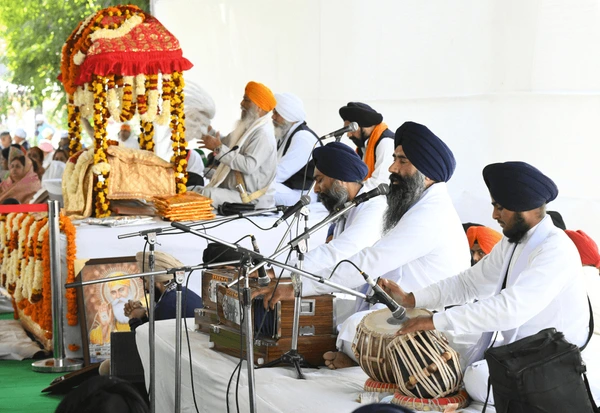
In Sikhism, Shabad and Kirtan are often described as the “heartbeat” of the faith. While the Akhand Paath is the continuous reading of the scripture, Shabad Kirtan is its musical soul—the act of singing those sacred verses to connect with the Divine.
Here is what makes Shabad Kirtan so special:
The Power of the “Shabad” (The Word)
In Sikhism, the Shabad isn’t just a lyric; it is the Guru itself in the form of sound. Sikhs believe that God is experienced through the “unstruck melody” (Anahad Shabad). By singing the Shabad, a person isn’t just reciting poetry—they are aligning their internal vibration with the divine wisdom of the Gurus.
Emotional Healing through Raags
The Guru Granth Sahib Ji is unique among world scriptures because it is entirely set to music. Its 5,867 hymns are organized into 31 specific Raags (musical measures).
Each Raag is chosen to evoke a specific emotional state—some bring deep longing, others bring intense joy, and some provide absolute calm.
The music acts as a “carrier wave,” helping the message of the words bypass the logical mind and go straight to the heart.
The Sangat: A Collective Voice
Unlike a concert where you listen to a performer, Kirtan is a communal experience.
The Ragis: These are the musicians who lead the singing, often using the harmonium and tabla.
The Sangat: The congregation is encouraged to sing along. There is a beautiful sense of equality when voices of all ages and backgrounds merge into one single, powerful sound. It reminds everyone that in the eyes of the Divine, we are all one.
A Remedy for the Ego
The Gurus taught that Kirtan is the “highest of all actions” in this age. It is described as a “medicine” for the mind. When you are immersed in the melody and the words, the “I” or the “ego” begins to fade away, replaced by a sense of humility and peace. It is a way to find a “sanctuary of sound” in the middle of a busy, stressful world.
Ardaas by Giani Ji
The Ardaas (or Ardas) is perhaps the most emotionally stirring and intimate ritual in Sikhism. While it is a “petition” or “prayer,” when it is led by a Giani Ji (a learned Sikh scholar or priest) in the presence of the Sangat (congregation), it becomes a powerful bridge between the past, the present, and the Divine.
Here is what makes the Ardaas led by a Giani Ji so profoundly beautiful:
A Living History
The Ardaas is unique because it isn’t just a request for the future; it is a recital of the past. As Giani Ji chants, he takes the congregation through a “roll call” of Sikh history.
He mentions the ten Gurus, the Panj Piare (Five Beloved Ones), and the countless martyrs who gave their lives for the faith.
By standing together and listening to this, the community is reminded that they are part of a long, brave lineage of resilience and sacrifice.
The Power of “Sarbat da Bhala”
The Ardaas is never purely selfish. It always concludes with the iconic plea: “Nanak Naam Chardi Kala, Tere Bhane Sarbat da Bhala.” * This translates to asking for high spirits and the well-being of all of humanity, not just Sikhs.
To hear a Giani Ji’s voice rise as he asks for peace and prosperity for every person on earth is a truly humbling and universal moment of grace.
A Voice for the Voiceless
One of the most touching roles of a Giani Ji during Ardaas is when he includes personal supplications.
People often approach Giani Ji to ask for a special prayer—perhaps for a sick family member, a student taking exams, or a couple starting a new life.
When Giani Ji weaves these personal names and needs into the formal prayer, it feels as though the entire community is standing with that individual, carrying their burden or sharing their joy.
The Atmosphere of Surrender
The physical posture of Ardaas is deeply symbolic. Everyone stands with folded hands (Kar Jori) and bowed heads.
There is no hierarchy; the wealthiest person and the humblest laborer stand side-by-side.
The rhythm of Giani Ji’s voice, punctuated by the congregation’s collective response of “Waheguru,” creates a meditative stillness. It is a moment where the ego is set aside, and everyone surrenders to the Divine Will (Hukam).
